We all are familiar with flu season. As December approaches people around us start getting feverish with some sort of monstrous flu; skipping work and school, grandparents in nursing homes being sent to the hospitals and the chaos of “there is a bug going around” takes over.
Working in a very high volume emergency department taught me that flu season really is just another way of saying “extremely high volume expected”. The flu season lasts from December to February, but it has been extending to May. I randomly came across the information that ozone impacts the respiratory system and was intrigued to know how this correlates with our current environment conditions and how this impact hospital visits.
36 Cities in the US and multiple locations in Japan and China show a significant correlation of ozone levels in the atmosphere and respiratory disease exacerbation. Specifically, exposure to ozone has shown to impact patients with chronic obstructive pulmonary disease as well as other forms of pulmonary diseases including pneumonia, influenza and asthma. There is decades worth of data indicating that Ozone causes adverse respiratory effects[1]
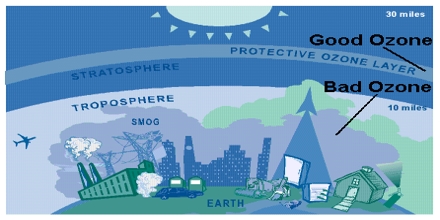
Weird. I thought Ozone was good. Yes, it is, but at a distance – literally. Ozone in the stratosphere is the one that protects us from the harmful radiation from the sun. But ozone in the troposphere is harmful. The Environmental Protection Agency reports that an ozone concentration of greater than 70 parts per billion (0.000007 %) is unhealthy for humans[2]. It’s also a greenhouse gas that contributes up to 30% for our detrimental climate change [3].
My Experiment: How does ozone impact flu season?
My hypothesis is that the exacerbation of the disease and increased number of hospitalizations over the years is correlated with the ozone concentrations in the troposphere.
As seen in hourly data, ozone concentrations in the atmosphere increase during the mid to late afternoon. A particular study has correlated this hourly analysis with the number of visits in the ED per hour and suggests that it may have a causal relationship with the increased volumes during the late afternoons. Although compelling, I believe there are a lot of other factors that contribute towards the increase in ED volumes in the late afternoon. These factors could include social reasons, convenience, degree of symptoms, cultural expectations etc.
Regardless, to analyze this on a higher level, if the total increase of troposphere ozone over the years or months has increased in correlation with the number of ED visits, hospitalizations or mortality rates due to respiratory disease, it may be convincing evidence of ozone’s impact on flu season.
- Monthly Analysis: According to the data obtained from ozone monitoring satellites [4], the surface ozone levels increase between the months of June – July in North America and are usually constant in the winter. Only in the South Atlantic sites does the ozone increase in January and December. Since the reported flu seasons for North America appear to be from December to May, this is inconsistent with my hypothesis that monthly changes in ozone concentrations may impact flu season.
- Yearly Analysis: Another thing I wanted to test was the yearly trends. I agree that the existence of flu is not dependent on ozone concentration, but what about the exacerbation. What if over the years, the ozone concentrations in winter have been increasing, thus causing a exacerbation of the flu season. I took some data to test this: Ozone Tropospheric concentrations from NOAA and the ED visits data from Canada Institution for Health Information. Based on my limited data, it seems like over the years, as ozone concentrations fluctuate in December, there is a correlation with ED visits for pneumonia and asthma.
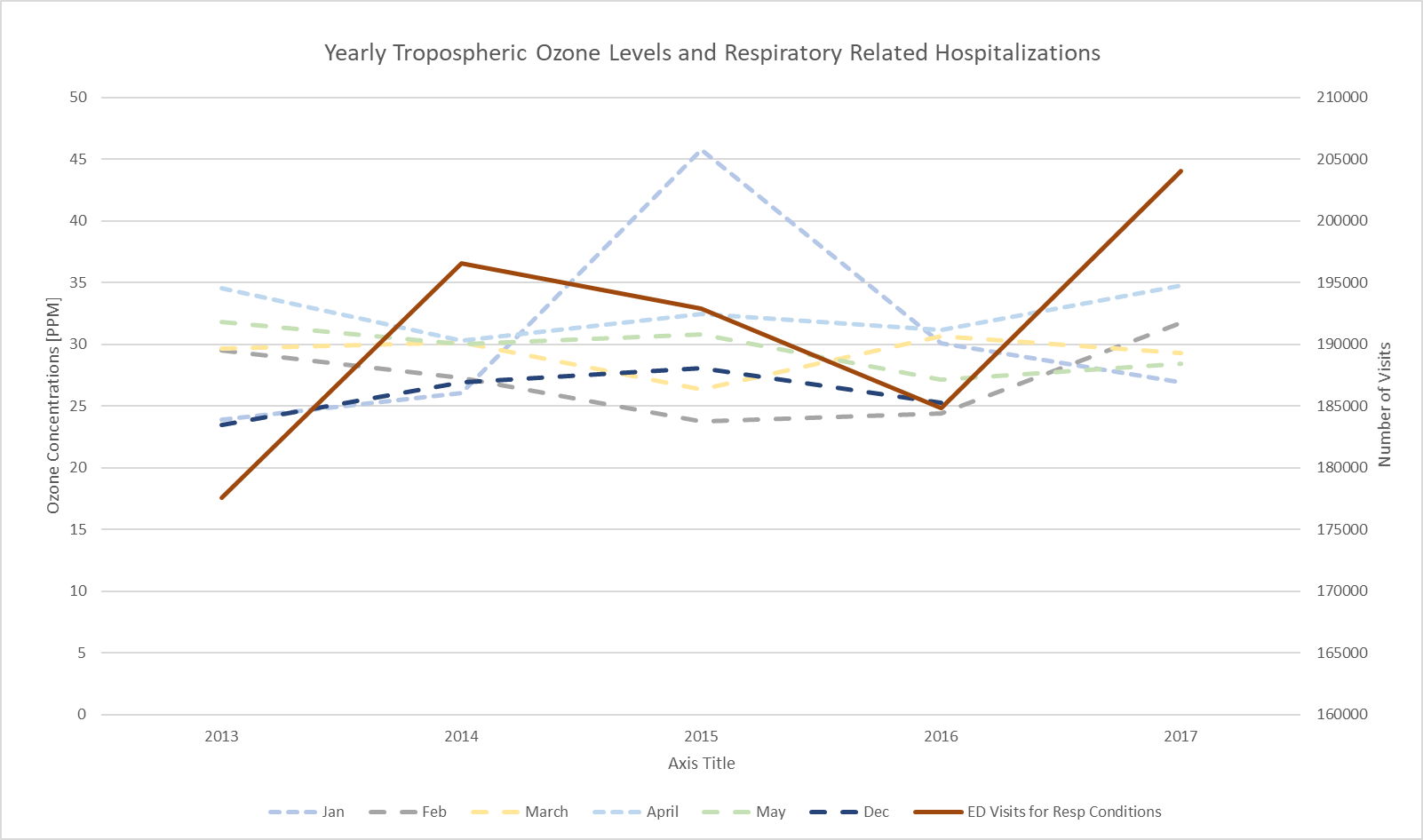
As there is only evidence for one out of the six months, this may not be enough evidence that ozone impacts flu season significantly; a lot more data analysis would be required to determine this. Currently, there are no data centers in Canada that monitor tropospheric ozone concentrations. Monitoring those concentrations and correlating with yearly trends could provide a better analysis of the situation.
Since there is significant evidence that ozone, has significant impact on respiratory condition exacerbation, its interesting to see that in a time analysis, it only seems to correlate in December. I will be keeping an eye out to see if I can further analyze some more data. Until then, Ciao.
References
 Surgeoneer