The healthcare cost in Canada has outgrown its generated economic growth rate, leaving us in a estimated $13 billion deficit [1][4]. Working in the hospital and seeing first-hand how despite of amazing technologies and solutions in the market, our patients still receive care in a sub-optimal workflows with sub-optimal technologies. My assessment is that this could be due to multiple things:
- Technologies themselves are not designed well enough to adapt to workflows, making them harder to be acquired (Innovation issue)
- Hospitals and other patient care delivery areas don’t have incentives to adapt better solutions for their patients (Systemic issue)
- Hospitals and other patient care areas don’t have enough funds to support the procurement and adaptation of these solutions (Commercialization issue)
Looking at the products that have regulatory approval by Health Canada but still fail to sell, its evident that there is more to the story than just regulatory approval. According to an intensive analysis on Canadian Startups [3], only 6% of Canadian companies actually stay in Canada to sell their products to Canadian customers. Multiple medtech news reports conclude that “there is no market in Canada”. Most of these companies that start off in Canada (before leaving to sell in the U.S) obviously identified a need and a market before going off to build a solution (hopefully). The barriers in getting the product to the market are quiet high, but I don’t see how that means that there is no market.
While trying to understand this problem on a high level I put together this info-graphic that summarizes how products are acquired by hospitals.
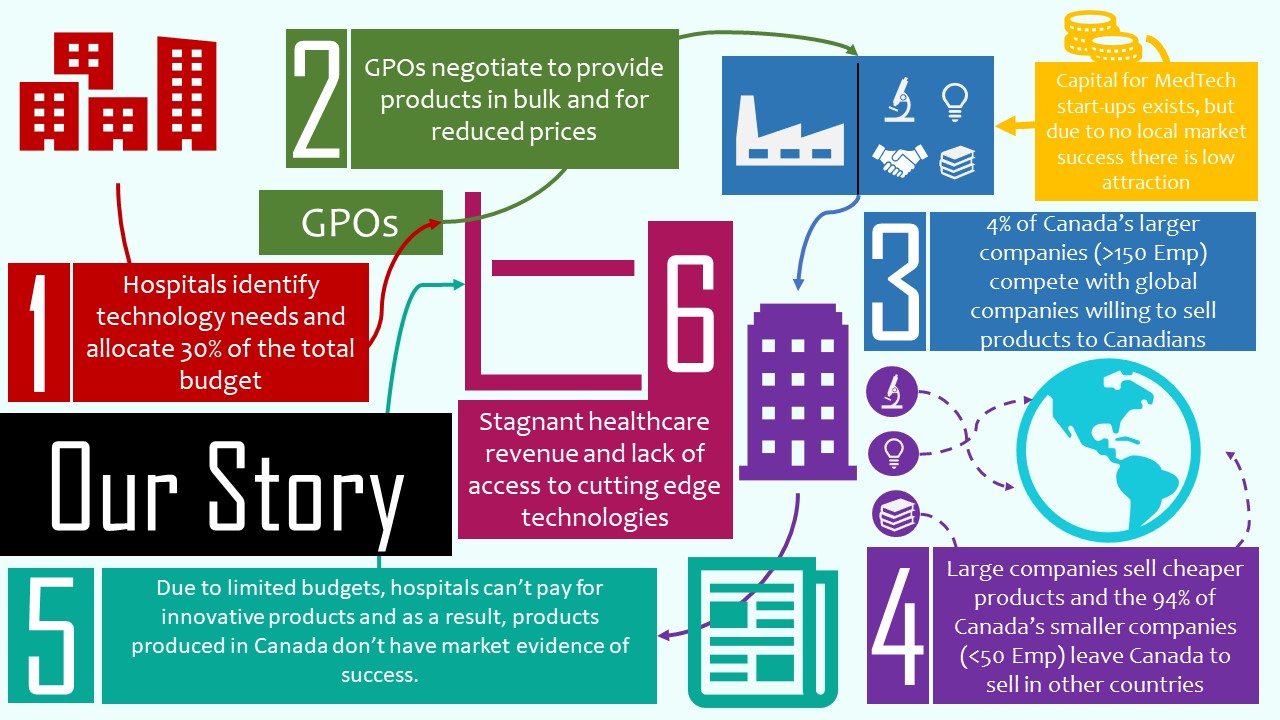
2- GPOs are group purchasing organizations that represent groups of hospitals to negotiate and buy products from medical device companies.
3. and 4. Information obtained from an analytical report: Transforming Canada into a Global Centre for Medical Device Innovation and Adoption
Opportunities
- On a large scale the physicians and clinical population may not be aware about solutions in the market and thus are not demanding optimized solutions from hospitals (Step 1)
- The smaller companies battling the larger companies in the private sector battlefield are loosing because they can’t sell products for better prices. (Step 4)
- The innovation process needs some reassessment due to the evidence that too often there are ideas that sound cool, but their integration and adaption in the actual clinical environment is sub-par. While designing solutions for the complex health system workflows, how are we integrating the end users: not just the physicians, but the nurses, clerks, hospital structures etc.? Are we focusing on process based solutions, or are we focusing on product only solutions that eventually fail? (more on this in another post)
- What incentives do hospitals have of adopting technologies? Currently, it just seems like an additional cost burden [for non-logistical solutions]. How do we align the hospitals goals with the intended goal of providing effective healthcare solutions?
As I dig deeper into this, I’m convinced that there are many components of the system that lack the incentive or drive to provide better solutions for patients. The government benefits from reduced cost to patient care when we develop solutions that reduce number of hospital visits and admissions; but at the end of the day the cost of acquiring these solutions comes from the hospitals who already have a very tight ship to run. This is one of the many examples in our system that shows how the current opposing economic forces are creating conflicts of interest and thus put us at a loss for adapting new technologies.
So whats the solution?
As I think about this my solution does evolve, but for now, here is how I re-think hospital function for supporting innovation:
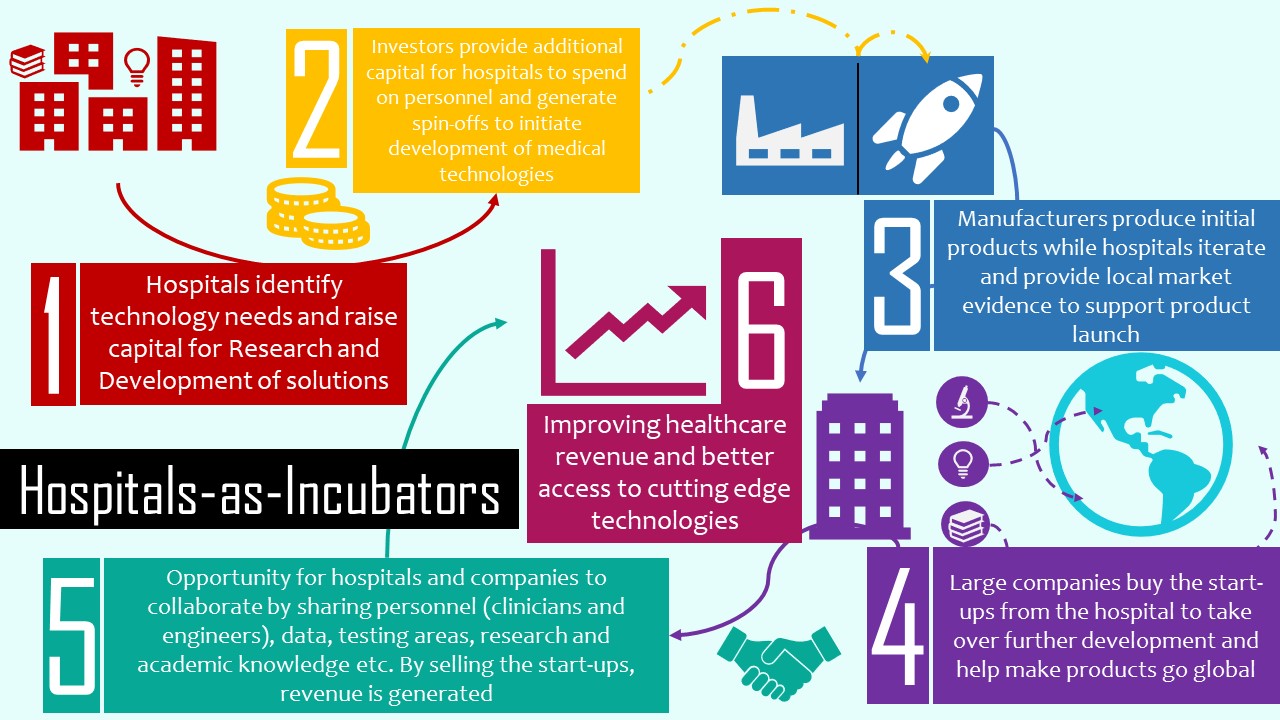
This model, or at least a version of it is adopted by Sunnybrook with many great outcomes and solutions! Until the next evolution of this solution, I hope that we can continue to fight for better technologies and better systems that allow us to access to them.
For inquiries, comments and feedback reach-out at communications@snoor.ca
References:
1- Health Spending: https://www.cihi.ca/en/health-spending
2- Hospital Spending: https://www.cihi.ca/en/what-are-hospitals-spending-on
3- Profit or Non-Profit: Are Hospitals Selling Out? http://www.cwhn.ca/en/node/39754
4- From here: 10% of Canada’s GDP is generated from Health care. Health Care is Good Medicine for Canada: https://www.conferenceboard.ca/press/newsrelease/13-01-31/Health_Care_is_Good_Medicine_for_Canada_s_Economy.aspx?AspxAutoDetectCookieSupport=1
5-Transforming Canada into a Global Centre for Medical Device Innovation and Adoption
 Surgeoneer